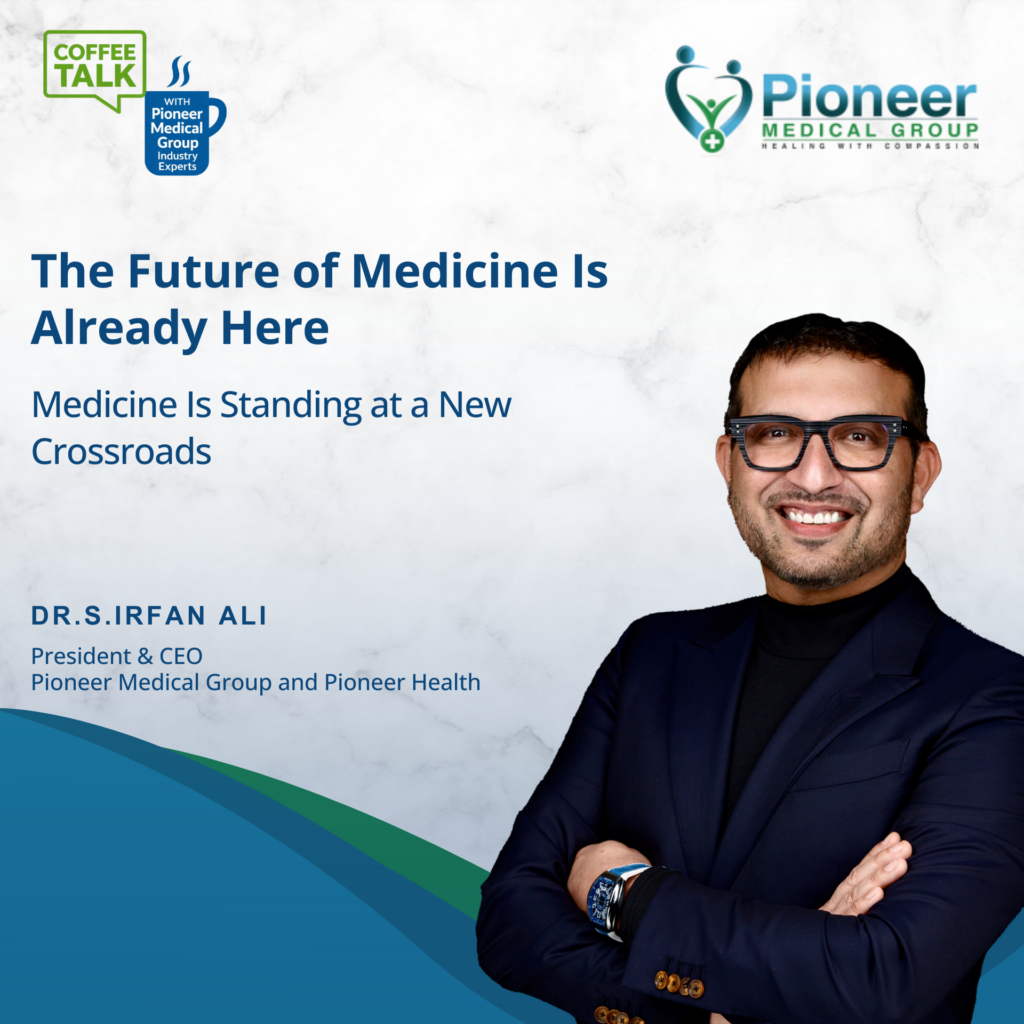
By S. Irfan Ali, M.D.
Most people think the future arrives slowly. We imagine decades passing between major breakthroughs, with change creeping in around the edges of our lives until we eventually look up and realize the world is different.
But there have been times throughout history when it appears we have come to a crossroads that offered us another path, a shorter one that accelerated our journey into the future.
At Pioneer Health’s recent IP Lung Symposium in Tampa, one of the most interesting themes from Dr. Irfan Ali’s keynote opening remarks wasn’t simply about artificial intelligence, robotics, or gene editing. It was the idea that we may be approaching such a crossroads now.
Dr. Ali compared today’s moment in medicine to the discovery of fire. Once humanity learned to harness fire, everything changed. It altered how people lived, ate, built communities, and advanced civilization itself. It didn’t happen slowly. I was an immediate shift for the people living at that time.
Are we living through another such time now?
According to Dr. Ali, medicine may now be standing at a similar crossroads. The difference is that many of the technologies people think of as future developments aren’t coming someday. They are already here.
The New Medical Crossroads
When people hear terms like artificial intelligence, robotic medicine, or gene editing, it’s easy to picture science fiction.
But many of these advances have already moved beyond theory.
At the Symposium, Dr. Ali highlighted examples ranging from AI-assisted drug discovery and robotic procedures performed across continents to gene editing technologies that are already changing treatment possibilities for some diseases.
Perhaps the most important takeaway wasn’t any single technology. It was the speed at which innovation is now occurring.
Historically, developing new therapies often required decades of research and testing. Today, emerging technologies can help researchers identify patterns, process enormous amounts of information, and accelerate discoveries in ways that simply weren’t possible before.
For physicians and healthcare organizations, this changes the conversation. Instead of asking whether healthcare will evolve, we are increasingly asking how quickly.
The Future of Healthcare May Become More Personal
One of the most fascinating concepts discussed during the Symposium involved the idea that healthcare could become increasingly individualized.
For decades, medicine often relied on broad populations and averages. Treatments were approved because they worked for many people. But emerging technologies are opening the possibility of tailoring care with far greater precision.
Imagine a world where disease risk can be identified earlier, where therapies become increasingly personalized, and where monitoring tools provide deeper insights into a patient’s health long before symptoms appear.
That future is becoming easier to imagine because parts of it already exist.
Of course, technology alone does not improve lives. Human expertise still matters. Relationships still matter. Compassion still matters.
The purpose of innovation is not to replace the physician or remove the human side of care. If anything, these tools may give healthcare professionals more information and better opportunities to intervene earlier and care for patients more effectively.
The future can sometimes feel overwhelming because we naturally focus on what might change. But one of the strongest messages from this year’s IP Lung Symposium was that these advances should also create optimism.
The future of medicine isn’t something waiting for us down the road.
In many ways, it’s already begun.
To learn more about Pioneer Health and our commitment to advancing patient care and innovation, contact our team today.
About the Author
For more information visit: irfanalimd.com | Instagram: @drirfanaliofficial | LinkedIn: S.Irfan Ali M.D.